
How much sun do different veg and herbs really need?
A common challenge of growing in containers in built up areas is sun - or, more accurately, lack of it. Patios, yards and balconies are often shaded by walls, neighbouring buildings or large trees. The concept of planting in ‘full sun’ - as seed packs often advise - is only a dream for many of us.
While the vast majority of edible plants do grow best in full sun (‘full sun’ is defined as six or more hours a day), it is possible to create a productive edible garden in less. You just need to be more selective about what you grow. Luckily, there is still lots of choice - as we will see.
Over the years, I’ve grown on a sunny patio and a sunny backyard - and on a shady balcony, a very shady back yard, and a partly sunny front yard. This post summarises my experience of what does - and what doesn’t - grow well in different amounts of sun.
When I started ‘serious’ growing in 2009, I found reliable information on how much sun different plants hard to come by. Perhaps this is because, historically, vegetables were (and most still are) grown in large gardens or allotments, where full sun isn’t a rare commodity.
Most garden literature, for example, advises that both chillies and rosemary need full sun. In practise, it turns out that chillies really do, but rosemary will grow fine in just three hours. Indeed most of the Mediterranean ‘sun loving’ herbs will grow ok in just a few hours of sun. True, they develop a bit less flavour - but, freshly picked, they still taste good.
As I experimented with different plants, a clear pattern emerged of how much sun different plants need:-
-
3-4 hours sun: all leafy veg, salad leaves and herbs plus woodland fruits.
-
5 - 6 hours sun: all root veg, plus peas and beans.
-
6 hours plus sun: all other fruiting veg (tomatoes, chillies etc), plus most other non woodland fruits like peaches and figs.
It’s not a foolproof system, but, as a rule of thumb, it’s surprisingly reliable. Follow it and you won’t often go wrong.
Here’s a more detailed breakdown of what grows well in different amounts of sun.
What grows well in 3 – 4 hours a day?
-
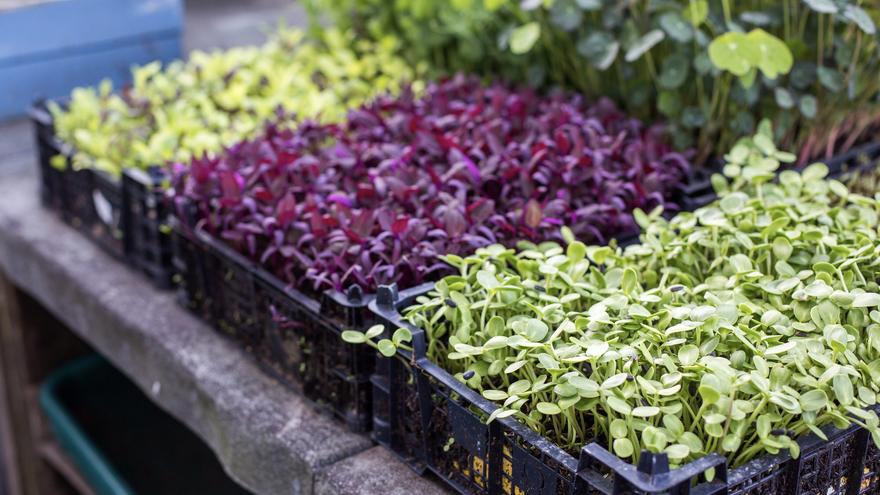
Microgreens. All microgreens grow strongly in just three hours sun - or even less. I’ve even grown them successfully in a back yard with no direct sun at all. The most delicious include sunflower shoots, pea shoots, rocket / arugula, coriander and radish. They are nutritious, delicious and one of the most productive choices for container gardening. A great one to try first in marginal spaces.
-
Nearly all salad leaves including lettuce, rocket, sorrel, orach, mustards like mizuna and mibuna, watercress, land cress, nasturtiums, winter purslane / claytonia, lambs lettuce / mache, chicory, endive will grow productively. Great news for the salad lover with a balcony or patio that doesn’t get full sun: a huge variety of tasty leaves awaits you.
-
Most leafy vegetables, including spinach, chard and kale.
-
Most herbs, including mint, coriander, parsley, bay, thyme, oregano, chives, garlic chives, sage, savory, and rosemary. Even basil will grow in three hours sun as long as it is kept warm - here in Newcastle I have to grow it on a windowsill inside for most of the year. A herb garden is a great way to transform low cost staples - like grains and pulses - into delicious and nutritious meals.
-
Woodland fruits - fruits that have evolved to grow in less sun include blueberries, blackberries, raspberries, gooseberries, Japanese wineberries, alpine strawberries (the small wild ones), black currants and red currants.
Although sun loving crops like chillies will struggle in 3 to 4 hours sun, I hope you can see that there is still lots of choice. Herbs and salad leaves are also amongst the very best things to grow at home - where you can pick them just as you need them.
What grows well in 5- 6 hours sun a day?
Everything listed above for 3-4h hours sun, plus:-
-
Most peas and beans, including French / pole beans, broad beans and runner / string beans. (Borlotti bean types are probably better in full sun). In urban spaces surrounded by walls, you’ll often notice that there is more sun higher up. Climbing peas and beans are a good way to utilise this.
-
Most root crops including radish, potatoes, spring onions / scallions, beetroot and carrots. It is possible to get a small harvest of many roots in just four hours sun, but most do become more productive in five or six hours. That said, I’ve grown spring onions and Jerusalem artichokes very successfully in just four hours sun.
-
Apples and pears will also grow and fruit well in 5 hours or more sun.
What plants grow well in 6 hours sun?
Most plants listed above will also grow well in full sun and most will grow even better. A few of the leafy crops - like lettuce and coriander - however don’t like it too hot. In very sunny spaces, keep these out of the midday sun if you can.
-
The crops that most need six hours sun to yield well include most of sub-tropical (originating from South America or South Asia) fruiting vegetables like tomatoes, squash, chillies, aubergines / eggplant, courgettes / zucchini, cucumber, and peppers. In less than six hours sun, the yield is often small or non-existent, or the fruits fail to ripen. If your space is a bit marginal and you are desperate to grow tomatoes, try small cherry varieties first - they ripen more easily than beefsteak varieties.
-
Strawberries, peaches, figs and hardy kiwis also grow best in full sun.
Try it and see
These rules of thumb will help you work out what to grow. Bear in mind, though, that every space is different, and it’s only by trying different things with an open mind that you learn what really works for you. Other factors like reflected light, warmth and wind can also impact on how well different plants grow.
It’s sometimes possible to push things. Some root veg will grow OK in four hours sun for example. But if sun loving crops like chillies and aubergines don’t have enough sun they are prone to grow weak, leggy and fail to ripen. This is often disappointing, particularly if you’ve put a lot of work into raising them.
One last observation. I’ve noticed from both my own personal experience and from helping others to grow that it is easy to be over optimistic about how much sun a space gets. So do try to be as realistic as you can.
How to work out how much sun your space gets
A simple and effective way to work out how many hours of sun a space gets, is to take photographs with your phone or camera every hour or two on a sunny day when you are at home. This will give you a visible record to review at the end of the day. You will see how the sun moves during the day, which areas get the most and least sun, and roughly how many hours of sun each part of, say your balcony, gets.
The free Sun Path App - available for both iPhone and Android - is also helpful for gauging how sun hours and patterns change through the year.
What’s your experience?
If you have succeeded in creating a productive garden in a space with only a few hours sun, it would be great to hear what grows best for you. Equally, if you have a very hot and sunny space - what do you grow and how do you manage?
Also, have you found any exceptions to my rough rules of thumb?

Want more practical container growing advice?
Join over 8,000 readers for seasonal tips, lessons from my own garden and ideas to help you grow more food in a small space. Free by email on Substack.
0 comments
Leave a comment