
How to Reuse Compost Successfully in Containers (and Save Money)

Reusing compost is one of the simplest ways to save money and reduce waste—and it can work surprisingly well for several years - and sometimes plants even grow better than in new compost! With planting-out season just getting underway, I thought I’d share a few thoughts on how to do it successfully.
Long-term readers may remember that, as an experiment, I grew tomatoes in the same pot and compost for six consecutive years (see photo above). To my surprise, they performed just as well each year. One pot contained a compost based on composted bark and wood, the other on coir—and both performed equally well.
How to re-use compost
1. Replace the nutrients
There are several ways to do this.
The simplest is to mix in a handful or two of a general-purpose organic fertiliser, such as blood, fish and bone, or a vegan equivalent. If you have access to homemade compost or worm compost, add some of that too. I also like to include a handful of seaweed meal for minerals, although this isn’t essential.
For leafy crops such as salads or kale, chicken manure pellets or rapeseed (canola) meal are both excellent options. These are rich in nitrogen (needed for leaf growth), but also contain phosphorus, potassium, and other important minerals. Chicken manure pellets are widely available in garden centres and sometimes even supermarkets. Rapeseed meal is harder to find in small quantities—it’s often sold as cattle feed—but it is available online, and is less smelly and easier to mix in than chicken manure. I bought 10 kilos once and it lasted me about eight years.
If you don’t have any suitable fertiliser, you can instead add 30–50% good-quality new compost. Either mix it in or simply add a fresh layer on top of the pot.
When sowing seeds directly into a container, I often add a 1–2 cm layer of new compost to the surface anyway. My theory is that seeds tend to germinate better in fresh compost—and it may also help hide the worms in my pots from blackbirds, which like to dig them up.
During the growing season, regular liquid feeds will also help keep plants productive.
2. Check the structure
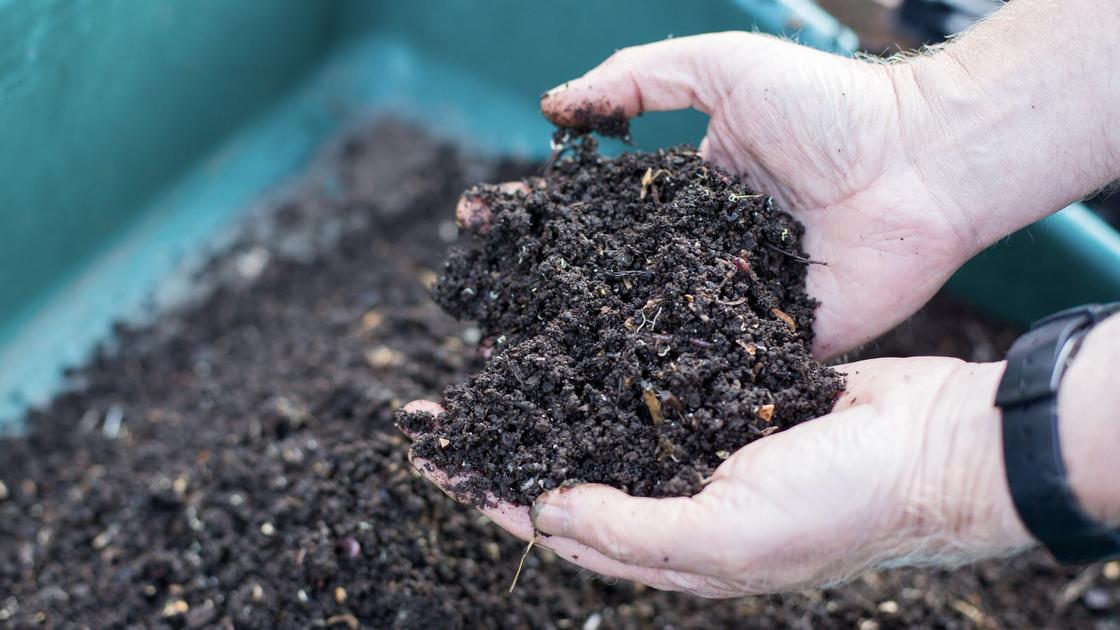
It’s also worth checking the structure of your compost before reusing it. Over time, compost can become compacted and lose some of its air spaces.
Pick up a handful and squeeze it. Ideally, it should feel crumbly. If it feels sticky or claggy, mix in materials that improve drainage and structure. Composted woodchip or coir (coconut fibre) work particularly well, but if you can’t find these, a few handfuls of new compost will help.
Interestingly, one advantage of many peat-free composts is that they tend to retain their structure better over time than peat-based composts.
No-dig container gardening
In larger containers, instead of mixing fertiliser or worm compost into the soil, you can try a no-dig approach. Cut the previous crop off at the base, leaving the roots to rot down in the compost. Then spread a layer of worm compost or fresh compost over the surface.
This mimics what happens in nature, where fertility is replenished by organic matter breaking down on the soil surface. My own trials suggest this works well - although I haven’t found it to be significantly better than other methods.
Are some plants easier to grow in old compost?
Your experience?
If you’ve reused compost before, I’d love to hear what’s worked for you - or any questions if you’re thinking of trying it this year.

Want more practical container growing advice?
Join over 8,000 readers for seasonal tips, lessons from my own garden and ideas to help you grow more food in a small space. Free by email on Substack.
0 comments
Leave a comment